





Beyond Price: Understanding the True Value of High-Performance Inks and Services
A value-driven approach to purchasing inks, coatings, and digital solutions in a competitive market
In print production, ink is often treated as a line item rather than a system. Price per pound is easy to compare and easy to document, which makes it a convenient metric for purchasing decisions. But convenience does not equal accuracy.
For printers, converters, and brand owners operating in complex production environments, price alone rarely reflects the true cost or the true benefit of an ink choice. The difference between low-priced inks and high-performance printing inks typically appears on press, where variables such as press stability, ink mileage, waste, and downtime directly influence print production efficiency.
Understanding value requires looking beyond price and examining how an ink system performs across the full production process.
Why Price and Cost Are Not the Same
The price of ink and the cost of running ink are not interchangeable. Two inks may differ only slightly in price yet produce significantly different outcomes once production begins.
A basic ink cost analysis often starts by selecting a discrete job on a specific substrate and calculating ink usage per unit, sheets, impressions, or linear footage. That metric is useful, but it represents only part of the picture. The total cost of ink is shaped by additional variables that affect throughput, waste, and labor over time.
In practice, small inefficiencies such as longer make-ready time, additional press adjustments, or incremental waste often have a greater impact on overall ink spend than purchase price alone. Improving outcomes in these areas depends less on cost-cutting and more on understanding pressroom productivity fundamentals that support stable, repeatable performance on press.
Performance and Press Stability in Print Production
Press stability is one of the most important contributors to efficient production. Inks that maintain consistent rheology, color strength, and cure behavior allow presses to operate closer to target speeds with fewer interruptions.
When ink performance is unstable, operators are forced to compensate by slowing the press, adjusting ink delivery, or stopping production altogether. These disruptions reduce press uptime and increase the cost per printed unit.
A key variable in this equation is the impact of ink viscosity control, which directly affects transfer, color density, and consistency throughout a run. Even minor viscosity fluctuations can introduce variation that compounds over time, especially on longer or multi-shift jobs. To minimize variability, many printers establish a baseline for how a press performs under controlled conditions using press fingerprinting: a process that helps identify normal operating ranges and isolate sources of variation across jobs and substrates.
High-performance ink systems are engineered to support stable operation within these defined parameters, reducing variability, and improving print production efficiency over time. The result is more consistent throughput, lower waste, and better utilization of press capacity.
DOWNLOAD
Make sure you are considering all press optimization variables
Download Print Variables List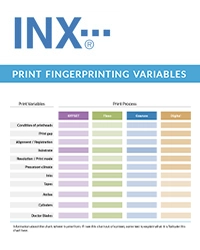
Consistency Across Jobs, Shifts, and Facilities
Ink consistency is not just a quality objective - it is an operational requirement.
Variability in ink formulation, color strength, or viscosity introduces uncertainty into the production process. That uncertainty increases the risk of rework, rejected product, and missed delivery schedules. For brand owners, it also compromises color repeatability across print runs and production sites.
Maintaining consistent ink performance depends on formulation control, documented quality processes, and an understanding of how inks interact with substrates and press conditions. When these factors are controlled, color tolerance targets are easier to maintain, and production becomes more predictable.
This relationship between ink consistency and throughput is closely tied to pressroom practices that support color control and productivity.
Hidden Cost Drivers in Ink Usage
A comprehensive printing ink cost vs value comparison must account for cost drivers that are not immediately visible on an invoice. Common contributors include:
- Color match time, including lost production during extended make-ready
- Substrate and ink waste, resulting from instability or rework
- Ink mileage, influenced by color strength, viscosity control, dilution ratios, and substrate absorption
- Press downtime, caused by cleaning, remakes, or inks that are not press-ready
Additional factors including transportation, inventory handling, process monitoring, and personnel time also contribute to operational cost, even when they are not directly assigned to ink.
Reducing these hidden costs requires a more strategic approach to ink purchasing, providing a practical framework for how to increase return on ink spend by improving efficiency, consistency, and press performance.
Measuring Throughput and Waste: The Formula
To assess ink system performance accurately, it must be measured against relevant production metrics.
Throughput is measured by:
- Average press speed
- Net feet/minute
- Net feet/hour
- Net feet/day
- Uptime percentage over a 24-hour period
The percentage of waste is calculated by reviewing:
- Overall print quality
- Defects
- Downtime required to clean plates
- The time needed to achieve the required color match
Below is an example of a total cost analysis for one of our customers that incorporates several of the above-mentioned KPIs.
Throughput Measured By: | Incumbent | INX | Difference |
|---|---|---|---|
| Net feet / hour | 63,000 | 102,000 | 39,999 |
| Time to complete | 31.7 hours | 19.6 hours | 12.1 hours |
| Machine rate cost / 2M feet | $25,260 | $15,680 | $9,680 |
Substrate Waste Contributors Measured By: | Incumbent | INX | Difference |
|---|---|---|---|
| % Total waste | 5.10% | 1.20% | 3.90% |
| Total waste in lbs. | 2242 lbs. | 528 lbs. | 1714 lbs. |
| Substrate cost / lb. - $1.04 | $2,332 | $549 | $1,783 |
These metrics allow printers to quantify how ink performance affects productivity and cost, providing a clear framework for how to conduct a total cost analysis for ink.
Quality Control and Technical Support
Ink performance is inseparable from process control. Even the best-formulated ink must be supported by effective quality control and technical expertise.
Ink manufacturers with documented QC procedures and controlled production processes deliver greater formulation consistency and repeatability. This consistency reduces variability and simplifies troubleshooting when conditions change.
Technical service plays a similar role. Access to knowledgeable support helps identify root causes quickly, reducing downtime, and preventing recurring issues. In this context, service functions as an operational resource rather than a reactive expense.
Equally important to reliable performance is a structured approach to machine upkeep. Understanding the benefits of standardized maintenance printing equipment helps sustain predictable press behavior and minimize unplanned stops, especially when multiple operators and shifts are involved. Regular, documented maintenance routines keep presses running as expected, reinforcing quality control and reducing variability in long-term performance.
CONTACT
Improve printing productivity in the pressroom while reducing applied costs
Contact a Technical Services Rep
Supply Reliability and Regulatory Readiness
Reliable ink supply is essential for maintaining production schedules. Inconsistent availability introduces operational risk and forces last-minute adjustments that increase cost and complexity.
Regulatory readiness is equally important. Ink systems developed without consideration for evolving compliance requirements can create future disruptions, including reformulation delays or qualification challenges. Inks designed with long-term regulatory and sustainability considerations help mitigate these risks and support continuity.
Evaluating Ink Value in Production
Comparing ink systems based only on purchase price overlooks the factors that most directly affect performance and cost in print production. Price per pound does not account for how ink behaves on press or how it impacts efficiency over time.
A meaningful evaluation considers total operating cost, including waste, downtime, labor, throughput, and service requirements. This type of ink cost analysis identifies where efficiency is gained or lost across the life of a job.
Ink systems that support press stability, color repeatability, and predictable throughput reduce variability and simplify process control. The resulting improvements in uptime, consistency, and resource utilization define ink value in practical, measurable terms.
Share