




Digital Can Printing at Scale: Where Chemistry Becomes Competitive Advantage
How ink system architecture determines adhesion, uptime, durability, and regulatory performance in beverage can production
Digital printing on beverage cans has moved beyond proof of concept. The technology is established, installations are expanding, and short-run, versioned packaging is now embedded within brand strategy. The conversation is no longer about whether digital works — it is about whether it performs with the consistency and reliability required for industrial production.
As digital can printing enters its next phase of market maturity, competitive differentiation is shifting. Hardware capability is increasingly standardized. What now determines scalable success is the architecture of the ink system itself — how chemistry behaves within the narrow operating window of high-speed beverage can manufacturing.
Aluminum substrates, applied coatings, elevated line speeds, aggressive downstream handling, and global regulatory requirements create one of the most demanding environments in digital packaging. Within that environment, ink chemistry governs adhesion, jetting stability, curing response, durability, and color control — not as isolated variables, but as an integrated performance system.
At scale, digital can printing is not a hardware challenge. It is a systems challenge. And the system is fundamentally chemical.
The Chemical Architecture Behind Digital Can Printing
Beverage cans represent one of the most demanding environments in digital packaging. Aluminum substrates, applied coatings, elevated line speeds, aggressive downstream handling, and global regulatory requirements converge with little tolerance for variability.
In this environment, performance variables often attributed to digital press platforms are, in reality, governed by ink system design. Adhesion consistency, jetting stability, cure balance, color control, and durability are not isolated mechanical outcomes — they are chemical behaviors operating within a tightly controlled manufacturing window.
Ink architecture determines:
- Wetting and anchoring behavior on coated aluminum at speed
- Droplet stability across extended runs and transient conditions
- Film formation under UV and UV LED curing constraints
- Resistance to mechanical, thermal, and environmental stress
- Color stability across frequent changeovers and variable throughput
As digital can printing transitions from qualification to continuous industrial production, these chemical variables determine whether the process operates as a stable manufacturing system or requires constant intervention.
The Hidden Constraints of Production-Scale Digital Can Printing
Adhesion Is a System-Level Outcome
Adhesion is not a singular event; it is the cumulative result of resin selection, surface energy interaction, cure kinetics, and film formation occurring within milliseconds.
Two-piece aluminum cans introduce coated substrates and minimal dwell time, requiring immediate anchoring without compromising downstream flexibility. Marginal adhesion may pass initial inspection yet fail later through abrasion, cracking, or visual degradation under real-world stress.
In production environments, delayed failure carries operational and brand risk. Adhesion performance must therefore be engineered with lifecycle durability in mind, not simply line survivability.
Jetting Stability Determines Uptime
At scale, jetting performance is defined by consistency rather than capability. Ink chemistry directly influences viscosity stability, resistance to premature polymerization, nozzle cleanliness, and maintenance intervals.
In multi-shift operations, minor instability compounds into lost uptime, increased cleaning cycles, and productivity erosion. Predictable jetting behavior is not a press adjustment; it is a chemical design parameter.
Transient Conditions Expose Chemistry Limits
Digital can lines rarely operate at steady-state. Ramp-ups, slowdowns, micro-stops, and SKU-driven speed variation stress ink systems beyond ideal laboratory conditions.
Chemistry must remain stable through these transitions to prevent density fluctuation, jetting artifacts, or cure imbalance without requiring constant operator intervention. Stability under dynamic conditions is what separates scalable chemistry from qualified chemistry.
Curing Is a Chemical Balance
UV and UV LED curing systems must deliver rapid polymerization with minimal heat input while achieving complete film formation. This balance depends on photoinitiator systems responsive to LED wavelengths and resin systems capable of rapid crosslinking without embrittlement—an area where advances in UV and LED ink platforms continue to redefine two-piece can printing performance.
Cure deficiencies are often subtle but directly impact abrasion resistance, chemical durability, and long-term appearance.
Color Stability Is a Process Variable
In high-mix beverage environments, color is not a static target but a dynamic production variable. Pigment dispersion stability, dot control, and resin–pigment interaction determine whether output remains consistent across changeovers, shifts, and facilities. When chemistry lacks inherent stability, operators compensate manually by introducing waste, variability, and extended makeready cycles that directly impact throughput and applied cost.
Even the most robust formulation requires disciplined color management to ensure production reliability. Through INX’s Color Center, combining ink expertise with equipment and workflow knowledge, decorators gain precise profiling, expanded gamut control, faster SKU transitions, and scalable global consistency while reducing operational risk and protecting brand integrity.
CONTACT
Solutions to reduce costs, speed products to market, and improve clients' brand image.
Contact a Color Management Rep
Durability Extends Beyond Processing
Pasteurization resistance is only a baseline requirement. Cold-chain condensation, ice immersion, retail handling, and secondary packaging abrasion impose cumulative stress on ink films over time.
Chemistry must protect visual integrity throughout the product lifecycle, not merely through the production line. Long-term durability safeguards both applied cost and brand equity.
Why Purpose-Built Ink Chemistry Matters
Ink systems adapted from flat packaging or label applications often struggle under the combined demands of aluminum substrates, LED curing, elevated line speeds, and beverage processing environments.
Purpose-built digital can inks are engineered around these constraints from inception. Platforms such as INXJet MDLM, recently introduced as a UV-curable inkjet system specifically developed for beverage cans, reflect a chemistry-first philosophy in which jetting behavior, adhesion, curing response, durability, and regulatory compliance are treated as an integrated architecture rather than isolated attributes.
DOWNLOAD
Learn how digital beverage can ink technology enhances production efficiency.
Download Technical Guide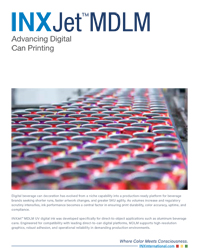
Drawing on decades of metal decorating expertise, the platform was designed to deliver industrial print quality, long-term durability, and regulatory alignment for high-speed digital can decorators operating at scale. This systems-level approach enables digital can printing to function with the stability, repeatability, and production reliability required for sustained deployment.
Regulatory Performance Must Be Engineered, Not Added
Digital beverage can inks operate within stringent global frameworks for indirect food contact. Compliance cannot be layered onto chemistry after performance targets are achieved; it must be built into the platform architecture.
Low-migration design, LED compatibility, and resistance to thermal and mechanical stress must coexist without compromising jetting stability or cure performance. As regulatory requirements evolve, chemistry platforms must adapt without destabilizing industrial reliability.
Chemistry Experience Reduces Operational Risk
Successfully navigating these constraints requires deep expertise in metal decorating chemistry. Aluminum can printing presents performance demands few digital applications replicate.
At INX International Ink Co., decades of metal decorating experience inform the development of digital inkjet systems for beverage cans. That foundation translates into ink platforms engineered for industrial duty cycles, global consistency, and predictable behavior across presses, plants, and regions.
For decorators, a chemistry-driven approach reduces qualification complexity, minimizes operational risk, and supports scalable digital integration.
The Next Phase of Digital Can Printing
As beverage portfolios fragment and product lifecycles compress, digital can printing will be evaluated less on image quality and more on reliability, integration, and production economics.
In this phase, ink chemistry becomes the primary enabler by quietly determining whether digital printing operates as a dependable production asset or remains a controlled variable requiring constant management.
The future of digital beverage can decoration belongs to solutions engineered for manufacturing reality, grounded in chemistry expertise, and validated under real-world canmaking conditions.
Share