





EU Food Contact Material Regulations for Inks & Packaging
What Manufacturers Need to Know to Stay Compliant and Sustainable
When it comes to food packaging safety in the EU, compliance is not optional– it’s essential. Food contact materials (FCMs), including printing inks, must meet strict regulatory requirements to ensure they do not harm consumers, alter food quality, or affect taste and smell. At the same time, these regulations increasingly emphasize sustainability and circular solutions.
This article breaks down the most important EU food packaging regulations, the role of printing inks, and what manufacturers need to prepare for as new legislation comes into force.
Regulation (EC) No 1935/2004: The Framework Regulation
The Framework Regulation has guided EU food packaging compliance since 2004. While it does not specifically name printing inks, it applies to all food contact materials (FCMs).The framework sets three non-negotiable requirements:
- Food packaging must not endanger human health.
- It must not alter the food’s organoleptic properties (appearance, smell, or taste).
- It must not transfer harmful substances into food.
These principles echo across subsequent EU regulations and national laws.
Regulation (EC) No 2023/2006: Good Manufacturing Practice (GMP)
Good Manufacturing Practice Regulation (EC) No 2023/2006 translates regulatory requirements into operational reality. Manufacturers of food contact materials must:
- Identify and control risks that could compromise compliance
- Adapt processes based on the sensitivity of the application and their role in the supply chain
- Apply tailored controls across different companies and product categories
Compliance isn’t one-size-fits-all. A company producing food contact coatings faces different challenges than a pigment supplier, yet the obligation to implement GMP remains universal. By embedding these practices into daily operations, manufacturers bridge the gap between regulation and real-world production.
Council of Europe Resolution AP(89)1: Colorants in Food Contact Plastics
AP(89)1 is not binding EU law but is widely referenced in national regulations. It sets purity requirements for pigments, limiting heavy metals and harmful impurities such as PAAs, sulfonated PAAs, and PCBs.
This resolution has influenced several regulations, including the Swiss Ordinance and German BfR recommendations, making it a critical compliance reference for ink manufacturers across Europe.
Plastics Implementing Measure (PIM) 10/2011
The PIM Regulation specifies limits on substances migrating from plastic food packaging into food. It does this through:
- Positive lists with specific migration limits (SMLs).
- Overall migration limits for materials.
- Pigment purity requirements aligned with AP(89)1.
While printing inks are not directly listed, the regulation defers to the framework regulation, reinforcing the obligation to prevent harmful migration. Amendments such as EU 231/2012 (purity requirements) and EU 2024/3190 (BPA restrictions) continue to tighten controls.
The German Printing Ink Ordinance (GIO)
Coming into force in 2026, the German Printing Ink Ordinance (GIO) sets strict limits on which substances can be used in inks for food packaging. Key provisions include:
- Positive list with migration limits for direct food contact inks.
- Migration limits and non-detect thresholds for unlisted substances for indirect food contact.
- Pigment purity requirements per BfR IX.
- Restrictions on nanomaterials and polymers based on monomers used.
The GIO applies only to intentionally added substances, provided non-intentionally added substances do not compromise framework regulation principles. Ink manufacturers will need to carefully manage both formulation and compliance documentation to meet these standards.
Swiss Ordinance 817.023.21 for Packaging Inks
Though not EU law, the Swiss Ordinance on Packaging Inks has long been a benchmark for ink compliance. It includes:
- A positive list of approved substances with SMLs
- A ban on intentionally added CMR substances
- Purity requirements based on AP(89)1
Because it is one of the most comprehensive ink regulations globally, many companies use it as a de facto compliance framework for food packaging inks.
The Future of EU Food Packaging Regulation
The European Commission’s reform agenda highlights sustainability as a central pillar, pushing manufacturers toward safer, circular solutions. Public consultations in 2023 revealed that the current framework regulation no longer aligns with consumer and industry expectations, prompting a delayed scoping paper now expected in 2026. Reform is anticipated to focus on two key objectives:
- Safe and sustainable FCMs
- Prioritization of substances
- Emphasis on sustainable alternatives
- Stronger evaluation of final materials
- Information exchange, compliance, and enforcement
- Greater supply chain transparency
- Systems for verifying compliance
- Standardized analytical methods
Until a harmonized update is enacted, member states are likely to diverge, increasing complexity for businesses operating across borders.
Innovations like Genesis® Washable Inks provide a practical path forward, enabling the recycling of PET films and labels, supporting circular economy initiatives, and aligning with emerging EU packaging compliance standards. By integrating high-performance, deinkable inks, manufacturers can meet sustainability goals today while preparing for regulatory changes tomorrow.
LINK
Genesis makes recycling plastic films used in packaging more efficient.
See if Genesis is right for you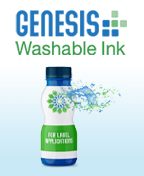
What This Means for Manufacturers
For ink and packaging producers, staying compliant means more than following today’s rules. It means preparing for tomorrow:
- Implement robust GMP systems tailored to your supply chain role
- Track purity and migration limits for pigments and raw materials
- Stay aligned with the GIO and Swiss Ordinance, even if you sell outside those markets
- Invest in sustainable alternatives, as upcoming EU policy will increasingly tie food safety and sustainability together
Industry guidance can help. The CEPE guidance on printing inks for FCMs provides additional clarity on aligning practices with regulatory expectations while maintaining safe, compliant products.
Safer Alternatives and Future-Proofing
The EU regulatory landscape for food contact materials is complex and rapidly evolving. While the framework regulation has provided consistency for two decades, new laws such as the German Printing Ink Ordinance and upcoming EU updates will reshape compliance expectations.
Manufacturers are now looking to safer, innovative alternatives to stay ahead. Innova Plus NCF, a nickel- and cobalt-free ink solution, exemplifies how forward-thinking formulations reduce potential risks, meet stricter safety standards, and prepare brands for future EU food contact material requirements.
Bottom Line
Ensure your inks and packaging not only protect consumer health but also deliver on sustainability goals. By staying ahead of regulatory changes and adopting safer, circular-friendly solutions like Genesis® Washable Inks, Innova Plus NCF, and recyclable substrates, companies can build trust, secure market access, and create long-term resilience, while reducing waste. Proving that responsible choices can also be smart business decisions.
Contact our regulatory experts about ensuring your inks meet EU food packaging standards
Share