




Top Color Management Tools for Consistent Print
How consistent color systems reduce waste, improve accuracy, and strengthen brand trust
In today’s competitive printing landscape, color isn’t just an aesthetic detail. It’s a business imperative. Whether you’re producing packaging, labels, or promotional materials, customers expect brand colors to be precise, repeatable, and consistent across every print run.
Strong color management practices are what make that possible. They minimize waste, speed up make-readies, and keep color predictable from proof to press. With the right systems in place, pressrooms work more efficiently and deliver the consistency customer’s demand.
The right tools extend that advantage even further. They help teams maintain accuracy, reduce costly errors, and streamline workflows from design through production, turning color confidence into a business advantage.
What Does Predictable Color Really Mean?
Predictable color means no surprises. This concept matters to every stakeholder in the print supply chain:
- Yesterday’s run matches today’s. Customers expect the same carton, label, or can they approved last week to look the same as what they receive tomorrow. Without predictability, brand consistency falls apart.
- The proof your client signed off on matches what rolls off your press. Proof-to-press alignment is a major driver of customer confidence. When your press output is accurate to the digital or physical proof, you avoid costly disputes and reprints.
- Every press, every shift, every location hits the same target. For multi-plant operations or global brand owners, consistency across facilities is critical. Predictability means no matter where the job is printed, the brand color remains the same.
Predictability isn’t just a quality benchmark– it’s the foundation of brand trust.
Essential Tools for a Color-Managed Pressroom
A predictable system isn’t built on one device or one process. It comes from a toolkit of proven solutions that work together. These tools, when integrated into your workflow, mean problems get solved before ink ever hits the substrate.
Here are the must-haves:
Spectrophotometers
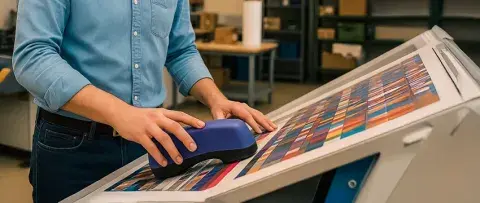
The backbone of accurate color measurement, spectrophotometers provide precise numerical values for color rather than relying on visual checks. Handheld units are useful for spot checks and approvals, while inline devices monitor color continuously during production. With this data, printers can document compliance with brand standards, speed up client approvals, and resolve disputes with objective data.

Color Management Software
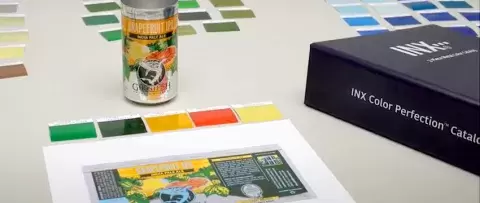
Software ties the entire workflow together. Platforms like INX Color Perfection integrate with cloud-based libraries, digital standards, and cloud-based systems so that designers, prepress teams, and press operators are all working toward the same target. This reduces miscommunication, prevents drift between departments, and ensures that “what you see is what you get.”
Learn more about INX Color Perfection
Automated Ink Dispensers
Ink mixing by hand can be slow, and while skilled operators may be more accurate with certain inks like pastes, automated dispensers calculate and deliver formulas consistently, helping converters manage dozens or hundreds of SKUs. This reduces guesswork, can save ink, and keeps costs under control.
Custom ICC Profiles & ISO Color Spaces
Every press, substrate, and ink set combination produces color differently. ISO color spaces are designed to reduce the need for custom ICC profiles, but there are times when tailored profiles are essential. ICCs provide a “translation layer” so what’s seen on screen in design software accurately represents what will print. The INX Color Perfection Team creates and maintains custom ICC profiles for RIP software and soft proofing when a standard color space does not apply, helping deliver reliable matches across jobs and substrates.
Closed-loop Control Systems
Even with the right setup, pressroom conditions can drift. Changes in temperature, humidity, paper stock, or operator input affect color. Closed-loop control systems monitor color continuously on press and automatically make adjustments to keep output within spec. This minimizes downtime, prevents out-of-tolerance runs, and saves costly rework.
Digital Proofing Tools
Proofing on press or with flat samples often leaves gaps. It can be difficult for brand owners to fully visualize how artwork will appear on the final package, especially when dealing with complex shapes or specialty substrates.
That’s where advanced proofing systems make a difference. By showing the final look earlier in the process, they reduce risk and speed approvals. For example, INX’s CP800 digital proofing system goes a step further by producing proofs directly on curved surfaces like beverage cans, allowing customers to see the exact finished product before committing to full production.
Where Things Break Down and How to Prevent It
Color often breaks down at the handoffs between teams. Each step in the process introduces risk if standards, profiles, or calibration are missing.
Design → Prepress
When designers deliver RGB files or omit the correct ICC profiles, prepress may interpret colors differently. The real issue isn’t just RGB vs CMYK, but whether proper ICC profiles are applied. Without them, proofs won’t align with brand expectations. Using standardized profiles, device calibration, and methods like G7 calibration ensures design intent carries through accurately.
Prepress → Press
If proofs are not consistent with press conditions, operators may waste time and materials trying to match targets. Variations in substrates, inks, and environmental conditions can compound the problem. Color management software and press-specific ICC profiles, built around an agreed-upon color space align proofs with press output, making the target clear and achievable.
Press → Finishing
Coatings, laminates, or varnishes can alter perceived color through changes in gloss, texture, or opacity. Without accounting for these finishing variables, the final product may not match the approved proof. Standardized targets and closed-loop press control systems allow adjustments before finishing, preventing costly rework.
By proactively locking in targets with tools like G7 calibration, correct color space targets, and closed-loop systems, printers can reduce waste, shorten make-ready times, and deliver consistent, brand-accurate color from design through final product.
The Business Case for Color Management
Color consistency is not just about aesthetics—it drives profitability:
- Faster make-readies. Standardized setups reduce trial-and-error, getting presses up to speed more quickly.
- Lower ink and substrate waste. Accurate targets mean fewer reprints, fewer adjustments, and less material wasted in setup.
- Fewer reprints and rejects. Predictability means customer approvals are more reliable, avoiding the cost of rejected shipments.
- More jobs per shift. Efficient, standardized color management shortens turnaround times and increases throughput.
In short, color management isn’t just a technical advantage. It’s a business strategy that saves money, reduces risk, and strengthens client relationships. As highlighted in this industry perspective, effective color management is also a discipline that drives efficiency and delivers measurable value to brand clients.
Why Shared Color Language Matters
Everyone involved in the workflow needs to “speak the same language” for color:
- G7 calibration in tandem with G7 derived color spaces provides a universal framework for alignment. This ensures printers, brand owners, and suppliers are aligned on measurable targets.
- Cloud based libraries and INX Color Catalogs create global consistency. They allow brands to specify and achieve accurate color reproduction anywhere in the world.
- Digital proofing ensures transparency.
- When all stakeholders view the same digital proof, approvals move faster and misunderstandings are minimized.
Shared standards are the bridge between creativity and production, strengthening trust and enabling smoother partnerships.
CONTACT
Ensure printing consistency and accuracy. Request a G7 Qualification Consultation.
Contact a G7 Specialist
How INX Helps Printers Achieve Consistency
Tools alone are not enough. People must know how to use it effectively. Many color management providers offer training programs, e-learning modules, and expert services to build internal expertise. A well-trained team makes better use of technology, reduces errors, and strengthens customer confidence.
Our Color Perfection Team and technical teams help customers:
- Select and integrate the right tools. We help customers choose equipment and software that fit their production environment.
- Build ICC profiles to help calibrate your devices. Profiles are customized to maximize accuracy and repeatability.
- Transition from manual mixing to automated dispensing. Customers save time and cut errors with technology-driven ink mixing.
- Train operators on G7 and advanced software. Our Color Perfection Team delivers hands-on education so teams can fully leverage technology to maintain accuracy. Readers new to G7 methodology can explore how this global standard provides consistency across multiple devices.
Our approach combines inks, coatings, technology, and training to deliver measurable results.
The Future of Color Control
Color management is rapidly evolving, with innovation focused on automation and data-driven insights:
- AI-driven correction. Algorithms that adjust on press in real time, reducing the need for operator intervention.
- Cloud data. Multi-site operations can maintain consistent standards across facilities with centralized control.
- Real-time analytics. Pressrooms can turn color data into actionable insights, tracking performance and preventing issues before they occur.
INX is actively testing and refining solutions so your pressroom stays ahead.
Ready to Build Predictable & Consistent Color into Your Pressroom?
Color consistency doesn’t happen by chance—it’s designed. With INX tools and expertise, you can make every run accurate, efficient, and predictable.
Learn more about our Color Management Solutions
INX International: Where Color Meets Consciousness
Share